

In large commercial construction defect lawsuits, proving structural failures is the foundation of your case, whether you’re seeking damages or defending against liability. Structural failures affect property value, safety, and business operations.
Without solid evidence and expert testimony, your construction defect claim crumbles.
This guide walks you through the evidence requirements, expert witness role, discovery strategy, and proof methodology in large Florida construction law cases.
What Proving Structural Failures mean in Construction Litigation?
Proving structural failures in construction litigation means establishing through credible evidence that:
- A defect in the building’s structural system exists and is documented
- The defect fails to meet Florida Building Code standards or the terms of the construction contract
- The defect was caused by negligence, breach of contract, or defective workmanship by an identifiable party
- The property owner or developer suffered quantifiable damages as a result
Florida courts, proving structural failures requires more than just identifying the defect, you must prove each element by clear and convincing evidence under Florida Statute § 90.702.
The presence of a structural defect alone is not enough, you must connect that defect directly to the defendant’s actions or omissions and prove causation.
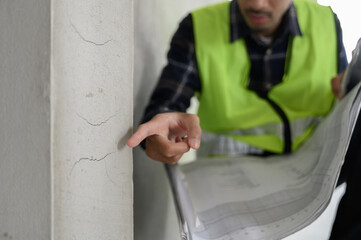
The Three Critical Elements for Proving Structural Failures Cases
1. Existence of a Structural Defect
The first step is proving the defect actually exists. This requires:
Physical Documentation
Photographic and video evidence showing visible cracking, displacement, water intrusion, or deterioration forms the visual record. Thermal imaging and moisture readings document hidden defects in structural cavities or under finish materials.
Structural Engineering Inspection Reports
An independent structural engineer must perform a hands-on inspection and issue a detailed written report. The report should include:
- Description of the defect’s location and extent
- Measurements of cracks, deflections, or gaps
- Comparison to building code standards and the original construction specifications
- Assessment of whether the defect poses an immediate safety risk
Testing and Analysis
For concrete defects, cores or petrographic analysis identify material quality issues. For steel, ultrasonic thickness testing or coating analysis reveals corrosion. Material testing proves whether the problem stems from defective materials or installation error.
This evidence must be admissible and defensible under Florida’s rules of evidence and expert testimony standards (Fla. Stat. § 90.702).
2. Non-Compliance with Building Code or Contract Standards
Once you’ve documented the defect, you must prove it violates applicable standards. In Florida, this typically means:
Florida Building Code Compliance
In Florida, this typically means compliance with the Florida Building Code, which adopts the International Building Code with Florida amendments. Your structural engineer must compare the defect to the applicable code section and explain how it fails.
For example, if foundation settlement exceeds acceptable limits under FBC Chapter 3, or if a load-bearing wall has insufficient shear transfer capacity per FBC Chapter 2, your expert must cite the specific code section and explain the deviation.
Contract Specifications
If the construction contract specified performance standards higher than code (common in commercial projects), you must prove the defect violates those contractual obligations.
Many commercial contracts include express warranties. Under Florida law, breach of express warranty is easier to prove than negligence, you need only show the condition fails to match the written promise.
3. Causation: Linking the Defect to a Responsible Party
This is where most cases succeed or fail. You must prove the defendant caused the defect.
Causation requires:
Identifying the Root Cause
A structural engineer’s causation analysis must determine how and why the defect occurred.
Root causes typically include:
- Design error (architect/engineer failed to calculate loads correctly)
- Material defect (concrete didn’t meet strength specifications)
- Workmanship error (improper installation, inadequate curing, missed code requirements)
- Inadequate supervision (general contractor failed to oversee subcontractors)
Determining causation often requires commercial litigation discovery and expert analysis to connect the defect to the defendant’s actions.
Eliminating Alternative Causes
Your expert must address and rule out competing explanations:
- Was the defect caused by normal wear and tear? (Prove it occurred within reasonable time after completion.)
- Could poor maintenance by the owner explain it? (Prove maintenance was adequate.)
- Is the defect due to site conditions the defendant should have anticipated? (Show it was predictable and addressable.)
Connecting the Cause to the Defendant
Finally, you must prove the defendant, contractor, architect, engineer, or material supplier, had the duty and failed to meet it:
- Did the general contractor supervise subcontractors? (Show they didn’t.)
- Did the architect review shop drawings? (Show they were inadequate or not reviewed.)
- Were materials tested before installation? (Show they weren’t, or were defective.)
How to Gather and Document Evidence for Proving Structural Failure Claims
Phase 1: Initial Documentation
Begin immediately. Delay weakens your case.
Preserve the Scene
Take dated photographs and video of all visible defects.
Capture:
- Cracks with a ruler showing scale
- Deflection or settlement from multiple angles
- Water stains, mold, or deterioration
- Relationship of the defect to surrounding areas
Collect Existing Records
Gather construction documents:
- As-built drawings and specifications
- Change orders and construction schedules
- Inspection reports from the permitting authority
- Builder’s warranty documentation
- Contractor invoices and material receipts
- Engineering reports from any prior investigations
These documents often prove what the contractor promised and whether they delivered.
Phase 2: Expert Structural Investigation
Hire a qualified structural engineer early. The engineer should:
- Conduct a Detailed Site Inspection: Measure, photograph, and document every aspect of the defect
- Obtain Building Permits and Inspections Records: From the local permitting authority to see what code requirements applied and whether inspections were passed
- Review Construction Documents: Compare the actual structure to the approved plans and specifications
- Test Materials: If necessary, perform concrete strength testing, steel coating analysis, or moisture testing
- Perform Calculations: Show mathematically that the structure fails to meet code or contract requirements
- Prepare a Written Report: Document all findings in a detailed, court-admissible engineering report
The engineering report is your backbone. It must be specific, measurable, and defensible.
Phase 3: Discovery – Obtaining the Defendant’s Evidence
In litigation, you can compel the defendant to produce:
Design and Construction Documents
- Structural drawings and calculations prepared by the engineer of record
- Change orders showing deviations from the original design
- Submittals and shop drawings approved by the architect or engineer
- RFIs (Requests for Information) revealing design ambiguities
- Construction schedules showing time pressures that may have compromised quality
Inspection and Testing Records
- Quality assurance inspection reports from the general contractor
- Third-party inspection reports (if the owner hired independent inspectors during construction)
- Material test reports showing concrete strength, steel properties, or other acceptance criteria
- Warranty claims or punch-list items showing the contractor knew about defects
Expert Reports
- Any reports or studies the defendant commissioned about the defect
- Expert opinions they may have obtained
- Damage assessment reports filed with insurance carriers
Communications
- Emails and correspondence showing knowledge of construction problems
- Meeting minutes discussing defects or code violations
- Change order requests revealing design or material issues
The Role of Expert Witness Testimony in Structural Failure Cases
In Florida, proving structural failures almost always requires expert testimony.
Under Fla. Stat. § 90.702, an expert may testify if:
- The expert has sufficient knowledge, skill, experience, training, or education
- The expert’s testimony is relevant and reliable
- The expert’s methodology is generally accepted in the professional community
Qualifying Your Structural Engineer
Your expert must be a licensed Professional Engineer (PE) with:
- At least 10+ years of structural engineering experience
- Specific experience investigating construction defects
- Familiarity with Florida Building Code and local construction practices
- No financial interest in the outcome beyond their fee (independence is critical)
The defendant will challenge any expert who:
- Is a professional advocate hired for litigation (jurat-only expert)
- Lacks specific experience in the type of defect being analyzed
- Uses novel or non-standard methodologies
- Has a track record of biased opinions
What Your Expert Will Testify To
Your structural engineer will provide expert opinion on:
- Existence and Extent of Defect: “The foundation has settled 2.5 inches beyond acceptable limits.”
- Code Violation: “This settlement exceeds the limits in FBC Section 3.2 (now IBC 2020 equivalency).”
- Causation: “The settlement was caused by inadequate soil bearing capacity, which should have been identified in the geotechnical investigation.”
- Defendant’s Role: “The structural engineer failed to require a soil boring, which is a standard of care for foundation design.”
- Damages: “Remediation requires underpinning at an estimated cost of $X.”
Expert testimony can be challenged through cross-examination, so your expert must be knowledgeable, composed, and clear in explanations.
Burden of Proof and Standard of Care in Florida Construction Defect Cases
The Standard: Breach of Professional Duty
In construction defect cases, the defendant’s conduct is measured against the professional standard of care: what a reasonably competent professional in their field would have done under similar circumstances.
For a general contractor, this means:
- Hiring qualified subcontractors
- Supervising work to ensure code compliance
- Testing materials before installation
- Following the specifications and change orders
For an architect or engineer, this means:
- Designing to code
- Reviewing shop drawings
- Performing site inspections
- Issuing stop-work orders for non-compliant work
For a material supplier, this means:
- Providing materials meeting specifications
- Testing materials before delivery
- Providing accurate documentation of material properties
Your expert must testify that the defendant fell below this standard.
Comparative Fault in Florida
Under Florida’s comparative fault rules (Fla. Stat. § 768.81), liability can be apportioned among multiple defendants. If the owner’s failure to maintain contributed to the defect, or if poor design combined with poor execution caused the problem, liability may be split.
This is why identifying all potentially responsible parties early is critical. Large commercial structures often involve multiple contractors, engineers, and designers, and each may share liability.
Timeline and Statute of Limitations in Structural Failure Cases
The Four-Year Rule
Under Florida law, construction defect claims must generally be filed within four years from the date the defect was discovered (or should have been discovered).
For structural failures, this is often:
- Completion of the building (if defects are obvious)
- First notice of property damage (water intrusion, settlement, cracking)
- Professional inspection revealing the defect
Critical: The statute of limitations can be earlier if the defect is latent. Courts may find the clock started when an owner had reason to suspect a defect, even if they didn’t obtain expert confirmation.
Preserving Evidence Early
Start the investigation immediately upon discovery.
Delayed investigation:
- Allows conditions to worsen (water damage spreads, deterioration accelerates)
- Makes it harder to prove when the defect originated
- Allows evidence to be destroyed or lost
- May result in comparative fault findings (owner negligence in failing to act)
Common Pitfalls in Proving Structural Failures
1. Hiring Unqualified Experts for Proving Structural Failures
A weak expert undermines your entire case.
Courts reject experts who:
- Lack specific experience in the type of defect
- Have been retained in numerous similar cases (litigation special vs. practicing engineer)
- Cannot explain their methodology in plain language
- Have financial incentives beyond standard expert fees
2. Confusing Defects with Design Differences
Not every construction difference is a defect.
You must prove the condition:
- Fails to meet code requirements, OR
- Breaches the contract specifications, AND
- Causes actual damage or safety risk
Cosmetic issues or minor variations from plans are typically not actionable.
3. Failing to Prove Causation
Establishing the defect exists is not enough. Many defect cases fail because the plaintiff cannot prove which defendant caused it. Multiple parties may have had a hand in the problem:
- Did the architect’s design fail to account for soil conditions?
- Did the contractor install materials outside the design envelope?
- Did the material supplier provide substandard concrete?
Without clear causation, liability is uncertain.
4. Missing the Statute of Limitations
Florida’s four-year deadline is firm. Owners often delay investigating to avoid alarming tenants or lenders, but delay costs them their legal right to recover. Start your investigation immediately upon suspicion of a defect.
5. Inadequate Documentation of Initial Conditions
Once litigation begins, the defect may be repaired or concealed. If you haven’t documented the original condition with photos, video, and expert reports, your proof is weakened.
Costs and Considerations in Proving Structural Failures Litigation
Expert Witness Costs
Structural engineering experts typically charge:
- Initial investigation and report: $5,000-$25,000 (depending on complexity)
- Deposition testimony: $2,000-$5,000 per day
- Trial testimony: $3,000-$10,000+ per day
Large commercial cases may require multiple experts (structural engineer, geotechnical engineer, contractor, architect). Budget accordingly.
Discovery Costs
Obtaining documents, conducting depositions, and retaining multiple experts in discovery phase can easily exceed $50,000 in a complex commercial case.
Damage Recovery vs. Defense Costs
Before proceeding, assess:
- Repair costs: What will remediation cost?
- Business interruption: What revenue was lost?
- Property value reduction: How much did the defect reduce market value?
- Legal fees: Will the recovery justify litigation costs?
Many large commercial cases settle once credible expert evidence is presented, which can save both sides substantial litigation costs.
Speak With a Florida Construction Defect Attorney
Proving Structural failures doesn’t resolve itself and the cost of delay is measured in lost evidence, missed deadlines, and weakened proof. An attorney’s early review of your defect claim, before you invest in expensive expert reports or litigation, can clarify your legal position, identify your strongest evidence, and prevent mistakes that compound after the statute of limitations ticks down.
At Southron Firm, we’ve guided Tampa contractors, developers, and property owners through construction defect cases for over a decade. The difference between a six-figure recovery and a dismissed claim often comes down to the decision made on day one.

This article is for general informational purposes only and does not constitute legal advice. Construction defect law is highly fact-specific, and the requirements for proof vary depending on the parties involved, the type of defect, and the court jurisdiction. The statute of limitations, burden of proof, and available remedies in your specific case require an attorney’s analysis of your facts. If you are facing a construction defect claim or seeking to pursue one, consult with an experienced construction law attorney immediately to protect your rights.
FAQ: Proving Structural Failures in Construction Defect Cases
What do you need to prove to win a structural failure construction defect lawsuit?
You must prove three elements: (1) a structural defect exists and is documented, (2) the defect violates the Florida Building Code or contract specifications, and (3) a specific party, contractor, architect, engineer, or supplier, caused the defect through negligence or breach of contract. Without all three elements, your claim will fail. Your structural engineer’s testimony is critical to establishing each element.
How do you prove a contractor caused a structural failure?
You prove contractor liability by showing: (1) they failed to supervise the work or hire qualified subcontractors, (2) they did not follow the specifications or building code, (3) they did not test materials before installation, or (4) they failed to halt non-compliant work when issues became apparent. Your expert and the construction documents, invoices, inspection records, change orders, show what the contractor was obligated to do and what they actually did.
What is considered evidence in a construction defect case?
Key evidence includes: structural engineering reports, photographs and video of the defect, construction documents (plans, specifications, change orders), building permit records and inspection reports, material test results, expert witness testimony, and communications (emails, meeting minutes) showing knowledge of the problem. Each category strengthens different elements of your proof.
Who can serve as an expert witness in a structural defect lawsuit in Florida?
A licensed Professional Engineer (PE) with at least 10+ years of structural engineering experience and specific background investigating construction defects can testify as an expert. Under Florida Statute § 90.702, the expert must have sufficient knowledge, skill, and experience in the relevant field, and their methodology must be generally accepted in the professional community. The expert cannot be a “professional advocate” or someone with a financial interest beyond their standard expert fee.
What is the role of a structural engineer in proving a construction defect?
The structural engineer investigates the defect, prepares a detailed written report documenting its existence and extent, compares the structure to the Florida Building Code and contract specifications, determines the root cause and which party is responsible, and provides expert testimony at deposition or trial. Their report is often the foundation of the case, without a credible engineer, the claim lacks the technical proof needed to win.
What is causation in a construction defect case, and why is it important?
Causation means proving that a specific defendant’s actions or negligence caused the structural defect. Simply showing a defect exists is not enough; you must prove who caused it and how. This is the hardest element to prove because multiple parties may have had a role, and you must eliminate alternative explanations (poor maintenance, owner negligence, natural wear). Without clear causation, a defendant can argue they are not responsible.
How long do you have to file a structural failure claim in Florida?
Under Florida law, construction defect claims must be filed within four years from the date the defect was discovered (or should have been discovered). For obvious structural failures like foundation settlement or major cracking, the clock typically starts at or shortly after completion. However, for latent defects, the clock may start later when the owner had reason to suspect a problem. Acting quickly is critical-delay can cost you your legal rights.
What happens if a builder denies liability for a structural failure?
If a builder denies liability, you must prove your case through discovery (documents and depositions), expert testimony, and evidence at trial. The builder will present their own experts to challenge causation, argue the defect was caused by factors outside their control, or claim the owner failed to maintain the property. Your proof must be stronger than theirs-this is why early expert investigation and thorough documentation are essential.